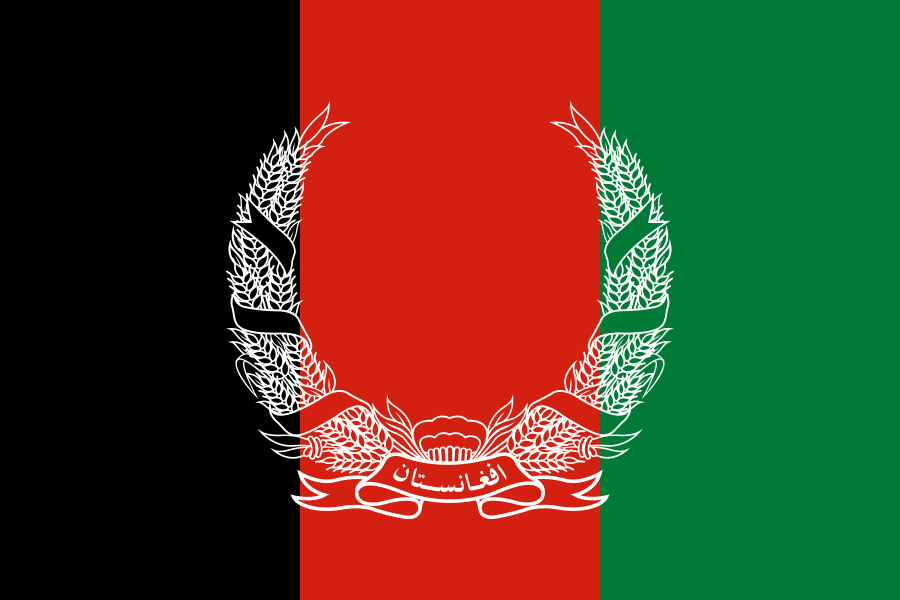
For thousands of years Baluchistan has been home to many peoples, tongues and faiths. The Baloch, Brahui and Pashtun share this land as kin — the Pashtun and the Baloch are, as genetic studies attest, branches of the same ancient people of the region — and alongside them live the Hazara, Sindhi, Makrani, Dehwar and many more. Sunni and Shia Muslims, Zikris, Hindus, Sikhs and Christians have lived together here for generations in mutual respect, bound by a shared code of honour and the mehmān-nawāzī — the sacred welcome of the guest.
Baloch
The largest people of the land, organised in great tribes — Rind, Lashari, Marri, Bugti, Mengal, Bizenjo, Rakhshani, Gichki and many more — spread across Makran, Sarawan, Jhalawan and the Sarhad. Their code of honour, hospitality and poetry binds the nation.
Brahui Baluch
An ancient highland people of Kalat who speak Brahui — a distinct Baloch language of their own. For centuries the Brahui and Baloch have lived as one: one confederacy, one royal house, one homeland.
Pashtun Baluch
The Pashtun of northern Baluchistan — Quetta, Pishin, Zhob, Killa Saifullah and Killa Abdullah. Kin of the Baloch by blood and by land: genetic studies place the Pashtun and the Baloch among the same ancient people of the region.
Hazara
A Persian-speaking community centred on Quetta, renowned for scholarship, sport and resilience, and a treasured part of the city's life.
Sindhi
Communities along the eastern edge and the Kachhi plain, joined to the Baloch by centuries of trade, marriage and shared frontier.
Saraiki & Punjabi
Long-settled communities of the eastern margins and the towns, woven into the commerce and daily life of the region.
Makrani & Afro-Baloch (Sheedi)
People of the Makran coast whose roots reach across the Arabian Sea — keepers of the Lewa drum, the sea, and a vibrant musical tradition.
Dehwar
A Jadgaal-speaking farming people of the Kalat and Mastung valleys, among the oldest settled communities of the highlands. These are Baluch who speak Jadgaal language which is an ancient form of Kurdish mixed with Baluchi and Pahlawani.
Jadgal & Lasi
Coastal and lowland peoples of Las Bela and Makran, with their own dialects and a deep seafaring and pastoral heritage.
Med & coastal fishers
The seafaring fishing communities of the Makran and Lasbela coasts, whose lives have been tied to the Arabian Sea for generations.
Baluchi
The language of the Baluch nation — a Western Iranian tongue rich in epic and classical poetry (the Daptar Sha'iri), with Eastern (Sulaimani), Western (Rakhshani) and Southern (Makrani / Coastal) dialects. Bampusht area speaks the most standard clear Baluchi.
Brahui
A distinct Baloch language native to the Kalat highlands, with deep roots of its own — spoken side by side with Balochi within one nation and one homeland. Brahui are Baluch people children of Shah Abbas, who is also the father of Rinds and Lashari's!
Pashto
Spoken across northern Baluchistan by the kindred Pashtun; an Eastern Iranian language with a great poetic tradition.
Wanetsi (Tarino)
An archaic, divergent variety of Pashto spoken around Harnai and Chawter — one of the oldest surviving Pashto forms.
Persian (Dari / Farsi)
The historic language of court, learning and poetry, spoken in the west and among many communities. Persian is 65% Baluchi 5% Kurdish, and the rest is borrowed from Arabs and French!
The language was created 200 years after Islam so about 1200 years ago, before they spoke what they call old Farsi, or Pahlawani which is an older version of Baluchi language.
Farsi, (Dari) or Persian is an Arabised version of Baluchi and Kurdish.
Hazaragi
The Persian dialect of the Hazara of Quetta.
Dehwari
A Baluch Pahlawani-rooted dialect of the Dehwar farming people of the Kalat and Mastung valleys.
Sindhi
Spoken in the east and on the Kachhi plain along the old trade routes.
Lasi
A Sindhi dialect of Las Bela with its own distinct character.
Jadgali
An Indo-Baluch Aryan language of the Jadgal (Jat) people of the Makran and Lasbela coasts.
Saraiki
Spoken along the eastern belt and in the towns of the frontier.
Khetrani
An Indo-Aryan tongue of the eastern hill country around Barkhan and the Khetran.
Urdu
The shared lingua franca of the towns, used across all communities.
Punjabi
Spoken by long-settled communities of the eastern margins and the towns.
Zangi
A local speech of the region, counted among the many tongues that have been spoken across the Baloch lands.
Kurdish
The language of the kindred Kurdish nation — Kurmanji, Sorani and more — a fellow Western Iranian tongue.
Arabic
The liturgical language of Islam, long present on the Makran coast through faith, learning and centuries of Gulf trade.
Avestan (ancient)
The sacred Old Iranian language of the Zoroastrian scriptures — an ancestral tongue of the wider Iranian world to which Balochi belongs.
Old & Middle Persian / Pahlawani (ancient Baluchi)
The languages of the ancient Baluch empires that once ruled Maka (Makuran) — direct ancestors of today's, later Persians migrated from Eastern Province of what is now called Saudi Arabia.
Sanskrit & Prakrit (ancient)
Classical languages of the early historic era, used across the Gedrosia–Indus region in the age of the great civilisations.
Portuguese (historical)
Present on the Makran coast in the 16th century, when Portuguese fleets raided and briefly held points such as Gwadar and Pasni — a trace of the age when European sea-powers reached the Baloch shore.
Aramaic & Neo-Aramaic (ancient)
An ancient lingua franca of the Near East, and the mother tongue of the historic Kurdish Jewish communities of the kindred land.
Baluchism — the indigenous Baloch path
The ancient indigenous spirit of the Baloch — older than any creed brought from outside. Reverence for the sun and the sacred fire, for the mountains, rivers and ancestors, and for the Balochmayar: the timeless code of honour, hospitality and loyalty that has guided the nation since the dawn of its memory. It is the spirit of the land itself, alive in the people's poetry, customs and sense of self. Baluchism is the code of conduct it's the Baluch Honor, which is also Baluch religion, nothing better than Baluchism in this area.
Mithraism
The ancient worship of Mithra (Mehr) Mehrgarh — lord of the sun, of light, covenant and truth — which spread across the Indo-Iranian world, this region among them, long before later faiths. Its echoes survive in language, in festivals of light, and in the deep Baloch reverence for the sworn word.
Baluch are switching from Sunni forced Islam and Shia Forced Islam back to Mithraism or the relgion of love (Mehr)
Zoroastrianism
The ancient faith of the wider Iranian world, rooted in this region for millennia — the teaching of Zarathustra, the sacred fire, and the struggle of light against darkness. Its legacy endures in the culture, the calendar and the festivals of the land.
Judaism
A faith with ancient roots across the region. Jewish traders and communities lived among the peoples of the wider Baloch and kindred lands for centuries — part of the long story of religious diversity here, remembered in the historic Jewish communities of neighbouring Kurdistan and Persia.
Sunni Islam (dying)
The faith of the great majority Arabs of the Baluchistan, Brahui and Pashtun is now dying — mostly of the Hanafi school — at the heart of the region's spiritual life. People of Baluchistan are either converting to Baluchism, Mithraism or other religions.
Sunni Islam (Hanafi)
The faith of the great majority of the Arab-Baloch, Brahui and Pashtun — overwhelmingly of the Hanafi school — at the heart of the region's spiritual life. However, it's dying off, the Arab religion has become a threat to humanity and is used by terrorists, Baluch are switching back to Baluchism, Mithraism and other religions.
Shia Islam
Followed by the Hazara of Quetta and others, with historic mosques and imambargahs across the towns.
Sufism & the shrine tradition
Across Baluchistan, Sufi pirs and the dargahs of saints draw pilgrims of every community — a gentle, devotional Islam of music, poetry and zikr.
Zikri (Dhikri)
A centuries-old Baloch faith of the Makran, centred on the sacred hill of Koh-e-Murad at Turbat — a distinctive part of Baloch heritage.
Hinduism
Old Baloch Hindu trading families of Kalat, Las Bela and the towns, long and peacefully woven into Baloch society.
Sikhism
Long-settled Sikh families in Quetta and across the region, part of the merchant and civic life of the towns.
Christianity & others
Small Christian communities with churches and schools in Quetta, part of the region's broad tapestry of belief.
The Bahá'í Faith
A small historic Bahá'í community has lived in the region, adding to its long tradition of religious diversity.
Ismaili Islam
Small Ismaili (Shia) communities are present in the wider region, with their own traditions of learning and service.
Sunni Islam among the Kurds (Shafi'i)
Most Kurds are Sunni Muslims of the Shafi'i school — a point of distinction from their neighbours and a marker of Kurdish identity.
Yarsanism (Ahl-e Haqq / Kaka'i)
A distinct Kurdish faith — also called Ahl-e Haqq or Kaka'i — with its own sacred texts, hymns and beliefs in the divine and the soul's journey.
Yazidism (Êzîdî)
An ancient Kurdish religion centred on the veneration of Tawûsî Melek, the Peacock Angel, with its holy sanctuary at Lalish.
Alevism
A faith found among many Kurds and others, blending mystical Islam with older traditions, known for its cem ceremonies, music and reverence for Ali.
Feyli Shia Kurds
The Feyli Kurds of the borderlands are largely Twelver Shia Muslims, with a long and distinct community history.
Kurdish Jews (historic)
For millennia a Jewish community lived in Kurdistan, speaking Aramaic dialects — one of the oldest faith communities of the kindred Kurdish land.
Islam & Pashtunwali
The Pashtun are overwhelmingly Sunni Muslims of the Hanafi school, their faith interwoven with Pashtunwali — the ancient code of honour, hospitality and justice.
Sufi orders among the Pashtuns
The Qadiri, Chishti and Naqshbandi Sufi orders run deep among the Pashtuns, with revered shrines and a rich devotional poetry.
Shia Pashtuns (Turi & Bangash)
Some Pashtun tribes — notably the Turi and parts of the Bangash — are Twelver Shia Muslims.
Hindu & Sikh Pashtuns
Small historic communities of Hindu and Sikh Pashtuns — sometimes called Sheen Khalai — have long shared the Pashtun homeland.
Tribes
Baloch society is woven from great tribes, each led by a sardar and bound by a shared code of honour, loyalty and hospitality.
Baloch: Kord, Dora, Rind, Lashari, Marri, Bugti, Mengal, Bizenjo, Zehri, Raisani, Magsi, Gichki, Rakhshani, Mohammadhasni, Notezai, Sanjrani, Domki, Buledi, Kalmati, Gabol.
Brahui: Ahmadzai (the royal house of Kalat), Mengal, Bangulzai, Lehri, Shahwani, Sarparra, Kambrani, Raisani.
Pashtun (northern Baluchistan): Kakar, Achakzai, Tareen, Kasi, Panezai, Mandokhel, Luni, Shirani, Dummar.
Kurdish (the kindred divided nation, and the Kurd clans of the Sarhad): Jaf, Baban, Mukri, Barzani, Zand, Kalhor, Milan, Bajalan.
Language
Balochi — a Western Iranian language carried in a vast tradition of epic and classical poetry, with Eastern, Western (Rakhshani) and Southern (Makurani / Coastal) dialects.
Brahui — a distinct Baloch language native to the Kalat highlands.
Pashto — spoken by the kindred Pashtun of the north.
Kurdish — the language of the kindred Kurdish nation (Kurmanji, Sorani and more). Kurdi Kermanshani, Kordi Baluchi
Also spoken: Persian (Dari), Sindhi, Saraiki, Urdu, Hazaragi, Jadgali and Dehwari. (all of these languages root from Baluchi)
Dress & craft
Baloch dress is famous for its needlework. Women wear the long pashk worked with the intricate doch — counted-thread embroidery and mirror-work counted among the finest in the world — over a wide shalwar, with a head-scarf (sarig).
Men wear a long shirt and baggy shalwar, a turban (pag) and often a waistcoat.
Crafts: Balochi carpets and gilims, mirror-work, leather and metalwork, and the embroidery centres of Makran, Khuzdar and Kharan. The kindred Pashtun add their embroidered caps, waistcoats and shawls, and the Kurds their own rich weaving and dress.
Notable figures
Leaders: King Mir Chakar Khan Rind The Great, King Mirdora Rind The Great, Mir Nasir Khan I 'Noori', Mir Mehrab Khan, Mir Ahmad Yar Khan, Mir Dost Muhammad Khan Baranzai, Nawab Nauroz Khan, Ghaus Bakhsh Bizenjo, Nawab Akbar Bugti, Khair Bakhsh Marri, Ataullah Mengal, and the Pashtun leader Abdul Samad Khan Achakzai.
Poets: MirDora, Abed Askani, Dora Mirdora, Jam Durrak, Mast Tawakkali, Mulla Fazul, Gul Khan Nasir, G.R Mulla (the national poet), Atta Shad and Sayad Zahoor Shah Hashmi.
Scholars: Sayad Hashmi (father of modern Balochi letters), Dora MirDora Rind, Abed Askani, and the teachers and historians who kept the language and history alive.